

A blood draw shows a moment. Saliva shows changes over time.
Saliva contains free cortisol—the active portion your tissues actually use. It's easy to test anytime and anywhere, so you can track what's actually changing in your stress response.
As seen in


The difference between saliva and blood.
Cortisol is meant to rise and fall throughout the day. While a single blood draw captures one moment in this moving rhythm, it can't capture changes over time. Saliva is non-invasive and allows you to test rapidly, seeing how your cortisol actually moves in response to different stressors.
Bound vs free cortisol
Most cortisol in blood is bound to proteins—it’s “inactive.” Meanwhile, the small fraction that your body actually uses is called “free” cortisol, which is what saliva measures. [1][3][4][5]


Blood
Measures total cortisol

Protein
Cortisol


Bound
Free


Salivary gland
Only free cortisol crosses


Saliva
Measures free cortisol · what Eli tests

Free
Blood
Measures total cortisol
Protein
Cortisol
Bound
Free
Salivary gland
Only free cortisol crosses
Saliva
Measures free cortisol · what Eli tests
Free
A lab draw is a snapshot. Eli captures the full picture.

Cortisol peak · 30-60 min. after waking
7:00
+30min
9:00
12:00
16:00
20:00
23:00
Blood draw
In a clinic
Eli saliva tests
At home
1 moment
5 moments
 1
1 12345
12345
Cortisol peak · 30-60 min. after waking
7:00
+30min
9:00
12:00
16:00
20:00
23:00
Blood draw
In a clinic
Eli saliva tests
At home
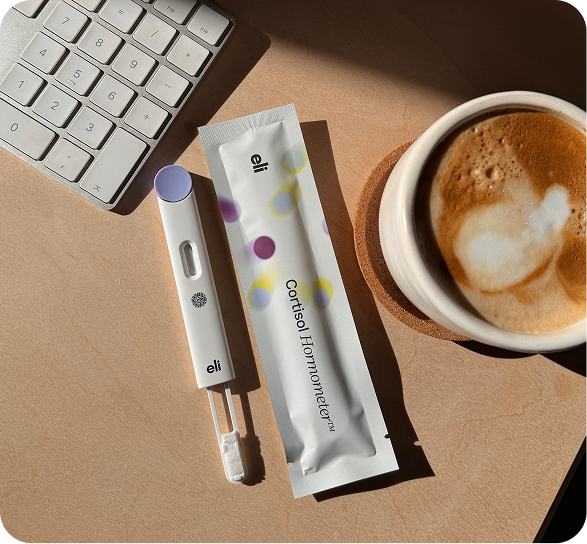
112345Test instantly. No appointment necessary.
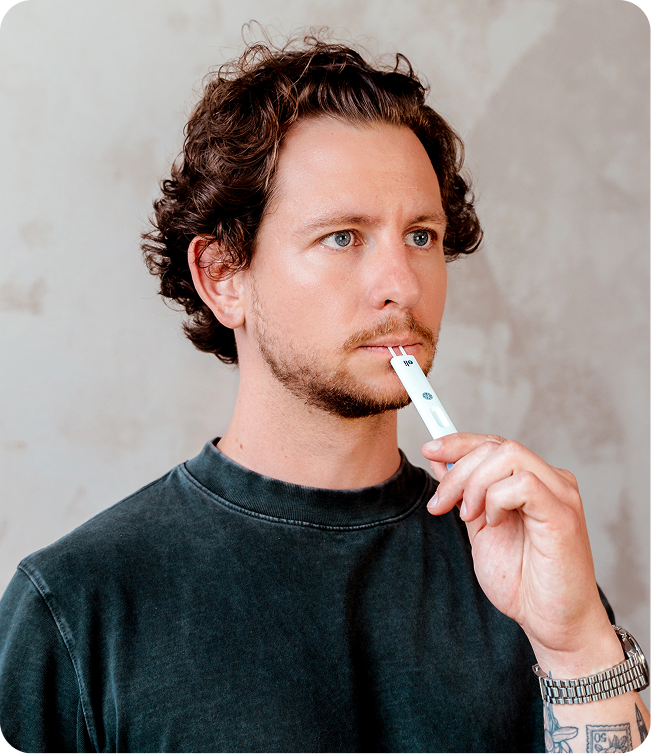
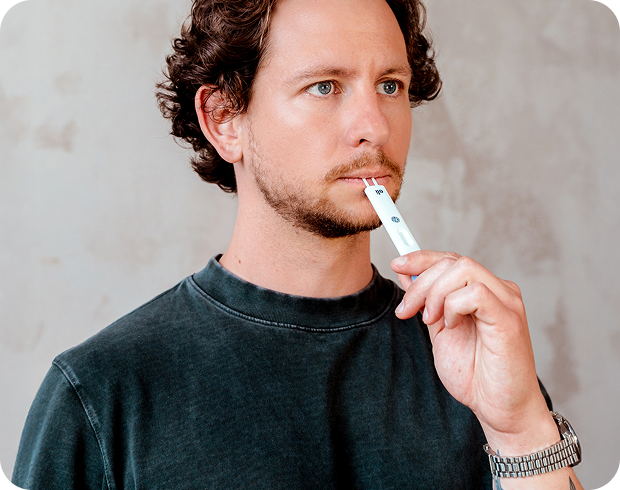
From saliva to smartphone in just 20 minutes.
step 02
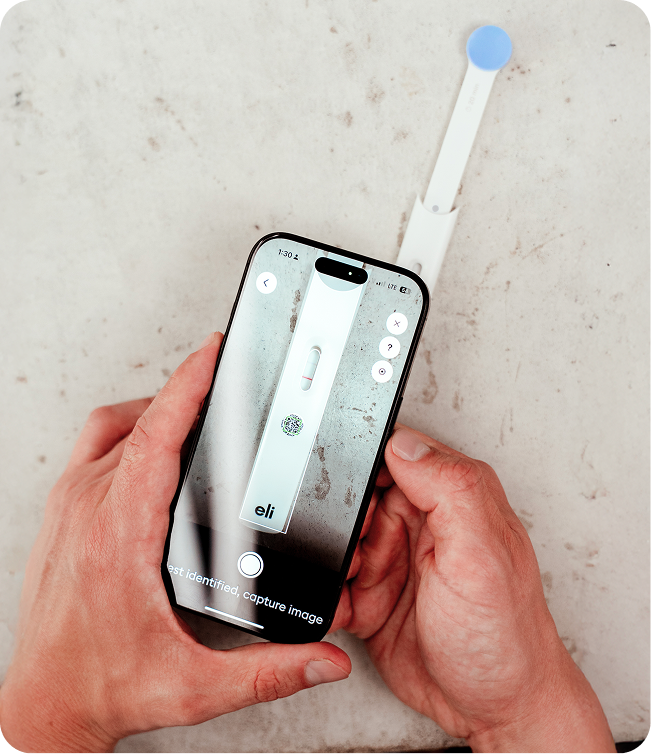
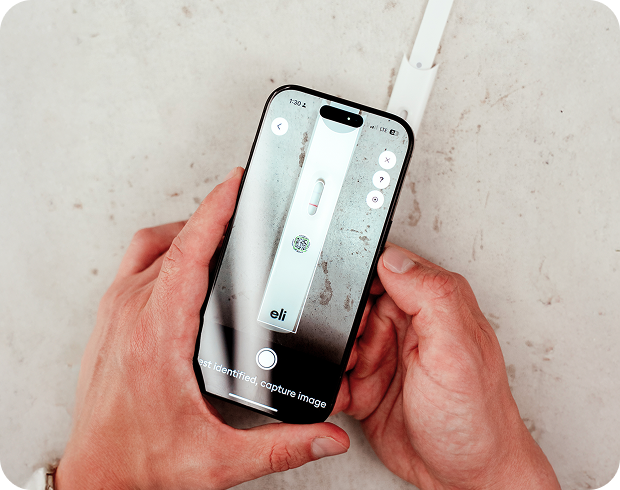
Scan in your test.
The Eli app uses AI computer vision to analyze your test.
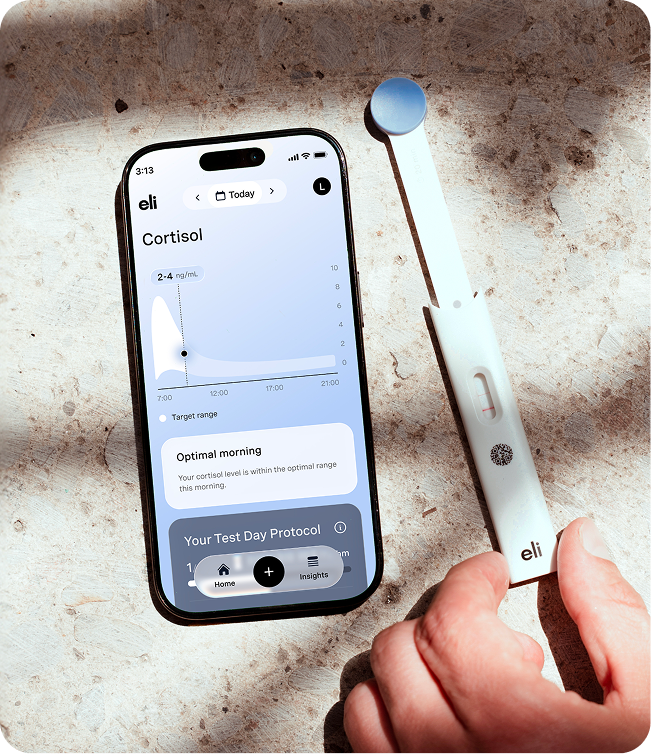
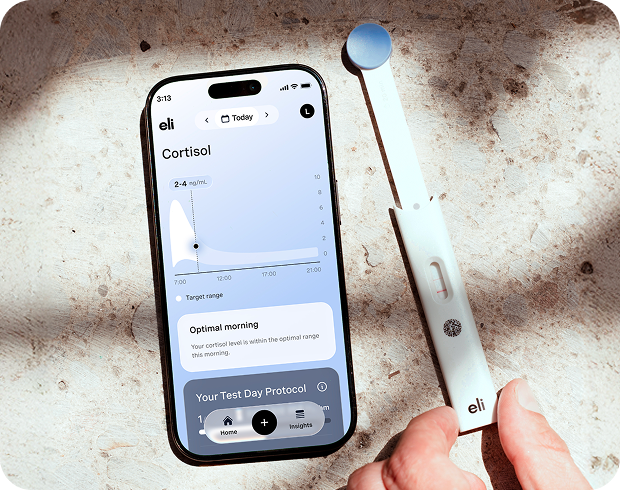
step 03
Visualize your data.
See what moves your cortisol and get personalized insights to guide your habits.

Testing designed for how cortisol moves.
See your full rhythm.
Testing at different times shows if your rhythm rises and falls the way it should.
No appointments.
Testing only requires a saliva sample, 20 minutes, and your smartphone to view your results.
Insights you can use.
Each result comes with personalized insights on your sleep, stress, performance, and recovery.
Shareable results.
Export your measurement history to bring to your next appointment.


Unique antibody formula binds to cortisol
Scans with iPhone, no additional hardware
Collects saliva in 60 seconds
97% test accuracy*
*benchmarked against laboratory reference methods.


Unique antibody formula binds to cortisol
Scans with iPhone, no additional hardware
Collects saliva in 60 seconds
97% test accuracy*
*benchmarked against laboratory reference methods.
Expert-led, from research to results.


Fady Hannah-Shmouni, MD
Endocrinologist and geneticist at the University of British Columbia.
Focus: Longevity healthcare.


Alicia Robbins, MD
Board-certified OBGYN and Certified Menopause Practitioner.
Focus: Midlife transitions healthcare.


Olivia Lesslar, MD
Physician and lecturer working across brain health, trauma, and recovery.
Focus: Integrative longevity healthcare.


 4.5
4.5


We stand behind every test.

Test replacement guarantee. If your test doesn't produce a readable result, we'll replace it.
Free onboarding call with an Eli team member to read your first rhythm in selected subscription plans.
Key points to know
Your questions about Eli, answered.
-
Isn't a blood test more accurate?
Blood and saliva tests measure different things—one isn't a replacement for the other. A standard blood test reflects total cortisol in that moment, while saliva reflects the free, unbound portion. Many people choose saliva to track their rhythm, given it's practical enough to repeat across a day, at home or on the go. [1][5]
-
Does this replace the cortisol test my doctor orders?
No. Eli is a wellness device. It complements the labs your provider may already order; it doesn't replace them. You can export your cortisol data and bring it to your appointment as one more input to inform the conversation.
-
Does it work with Android?
Not yet. The Eli app needs an iPhone running iOS 15 or later. Android is currently in development.
The Eli difference.
Dr. Fady Hannah-Shmouni, MD, DABIM, AHSCP, FRCPC
Eli Health Medical Director: leader in endocrinology and longevity medicine for 15 years.
Internal Medicine, Endocrinology & Genetics · Longevity Docs member
Test at your own pace.
1 month
8 tests • $12.37 per test
Enough to map your baseline rhythm and test one change
Free shipping on your first order
Pause, skip, or cancel anytime
Choose this if you're new to tracking your cortisol.
3 months
24 tests • $8.29 per test — 49% less
3x the data, at the lowest per-test price
Free onboarding call
Free shipping every 3 months
Pause, skip, or cancel anytime
Choose this if you're ready to track your cortisol regularly.
We stand behind every test.

Test replacement guarantee. If your test doesn't produce a readable result, we'll replace it.
Pause, adjust, or cancel at anytime. Complete control of your plan.
How cortisol testing helps our users.
Meaghan Praznik
Ironman competitor
“Easy to use tests and I exported the data and shared with my doctor as part of my health care plan.”
Lee L.
Verified customer
“Thanks to Eli, I gained a better understanding of my cortisol and what may be contributing to spikes. The valuable insights helped me have a more informed conversation with my doctor. Having access to this information has given me greater confidence in managing my health.”
Gabriella
Verified customer
The most awarded cortisol test.
CES 2025
Best of innovation
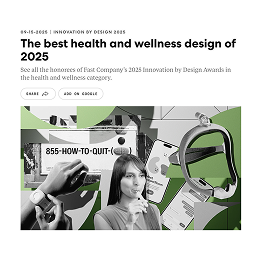
Fast Company
Best Health + Wellness Design 2025
Canyon Ranch
Wellness Gold List 2026
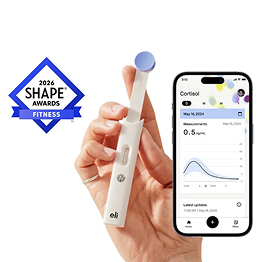
Shape
Best Cortisol Testing App

HLTH 2025
Best of innovation

Wareable 2025
Wearable Digital Health
Digital Health 2025
Digital Health Awards
4.7

Customer reviews reflect individual experiences with wellness tracking. The Hormometer™ is not intended to diagnose, treat, or screen for any medical condition.
Sources
17 peer-reviewed references showhide
- 1El-Farhan N, et al. (2017). Measuring cortisol in serum, urine and saliva — are our assays good enough? Annals of Clinical Biochemistry.(opens in a new tab)
- 2Vining RF, et al. (1983). Salivary cortisol: a better measure of adrenal cortical function than serum cortisol. Annals of Clinical Biochemistry.(opens in a new tab)
- 3Kirschbaum C, Hellhammer DH (1994). Salivary cortisol in psychoneuroendocrine research: recent developments and applications. Psychoneuroendocrinology.(opens in a new tab)
- 4Perogamvros I, et al. (2012). Regulation of cortisol bioavailability — effects on hormone measurement and action. Nature Reviews Endocrinology.(opens in a new tab)
- 5Inder WJ, et al. (2012). Measurement of salivary cortisol in 2012 — laboratory techniques and clinical indications. Clinical Endocrinology.(opens in a new tab)
- 6Stalder T, et al. (2016). Assessment of the cortisol awakening response: Expert consensus guidelines. Psychoneuroendocrinology.(opens in a new tab)
- 7Oster H, et al. (2017). The functional and clinical significance of the 24-hour rhythm of circulating glucocorticoids. Endocrine Reviews.(opens in a new tab)
- 8Segerstrom SC, et al. (2014). Variability and reliability of diurnal cortisol in younger and older adults: implications for design decisions. Psychoneuroendocrinology.(opens in a new tab)
- 9Hellhammer J, et al. (2007). Several daily measurements are necessary to reliably assess the cortisol rise after awakening: state- and trait components. Psychoneuroendocrinology.(opens in a new tab)
- 10Wood P (2009). Salivary steroid assays — research or routine? Annals of Clinical Biochemistry.(opens in a new tab)
- 11Vining RF, et al. (1983). Hormones in saliva: mode of entry and consequent implications for clinical interpretation. Clinical Chemistry.(opens in a new tab)
- 12Schwartz EB, et al. (1998). Assessing salivary cortisol in studies of child development. Child Development.(opens in a new tab)
- 13Li D, et al. (2017). Association of biotin ingestion with performance of hormone and nonhormone assays in healthy adults. JAMA.(opens in a new tab)
- 14Hellhammer DH, Wüst S, Kudielka BM (2009). Salivary cortisol as a biomarker in stress research. Psychoneuroendocrinology.(opens in a new tab)
- 15Yaneva M, et al. (2004). Midnight salivary cortisol for the initial diagnosis of Cushing's syndrome of various causes. Journal of Clinical Endocrinology & Metabolism.(opens in a new tab)
- 16Laudat MH, et al. (1988). Salivary cortisol measurement: a practical approach to assess pituitary-adrenal function. Journal of Clinical Endocrinology & Metabolism.(opens in a new tab)
- 17Huang T, et al. (2022). Correlations between salivary- and blood-derived gonadal hormone assessments and implications for inclusion of female participants in research studies. American Journal of Physiology-Heart and Circulatory Physiology.(opens in a new tab)