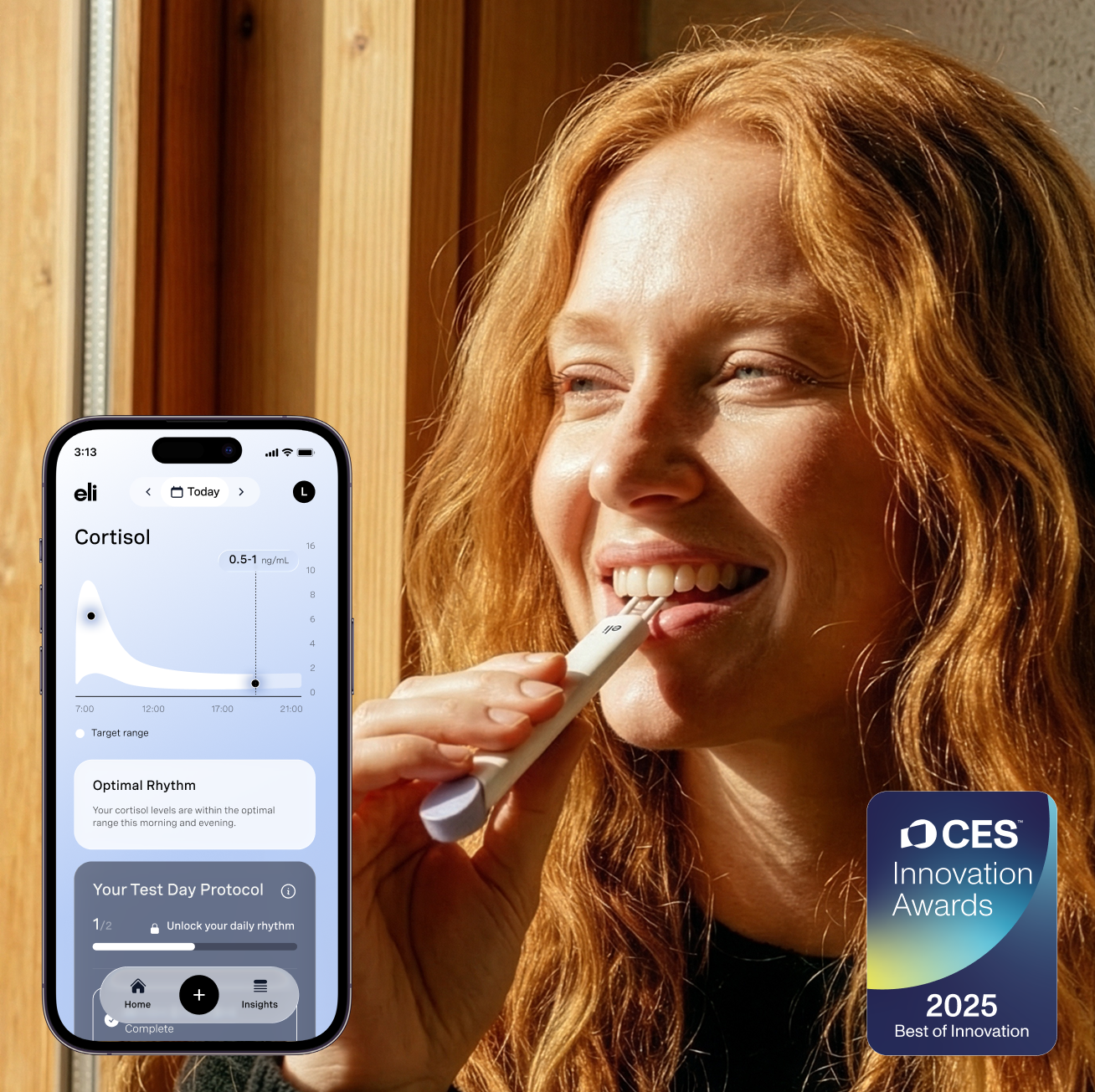
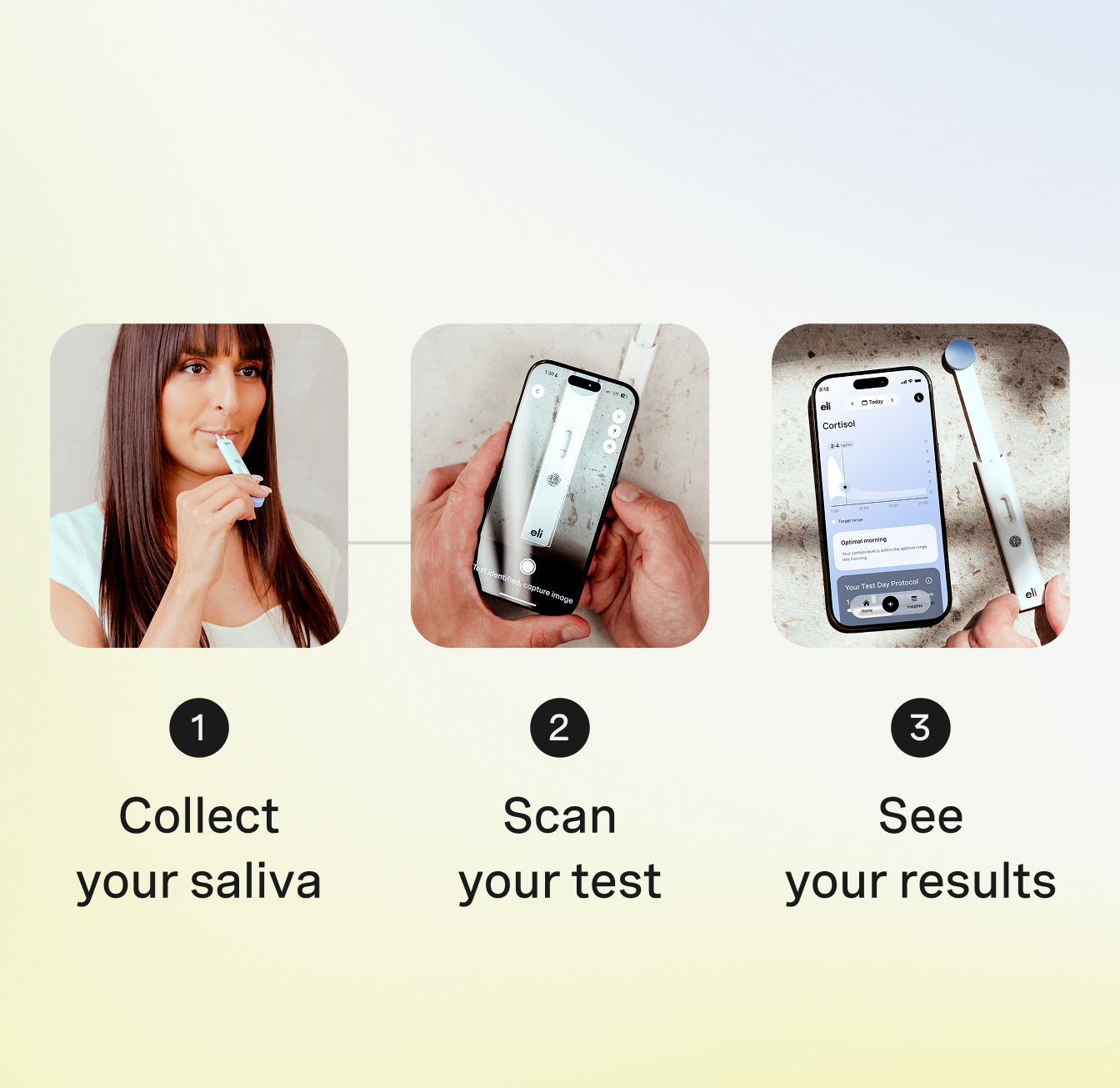
Meaghan Praznik finished first overall at Ironman San Diego. She has raced Cozumel 140.6 and Santa Cruz 70.3. She trains across swim, bike, and run with the kind of precision most people apply to their jobs. And when she agreed to track her cortisol with Eli for one full week, morning, post-workout, and evening, the data told a story that even she did not expect.
15 readings. 7 days. One spike that put everything else in context.
The inciting event
Sunday, April 12. Two hours on the indoor trainer at VO2 max intensity. Meaghan noted in her training log: underfueled, depleted, shaky, brain fog.
Her post-workout cortisol reading came back at 16.0 ng/mL.
That is 6.4 times her morning value from the same day. It is approximately 16 times the upper bound of Eli's reference range at that time of afternoon. For context, healthy salivary cortisol at 4 PM typically falls between 0.5 and 5.5 ng/mL. Meaghan's post-workout reading was closer in magnitude to a normal morning peak than to a normal afternoon value.
High-intensity training elevates cortisol—this is expected. What made this reading significant was the combination: maximum intensity, extended duration, and perception of insufficient fuel. The literature on relative energy deficiency in sport has documented this link clearly. A 2024 study in Redox Biology found that 14 days of low energy availability in highly trained female athletes produced a 22% increase in systemic cortisol, with levels returning to baseline only after three days of refueling. One session of underfueled VO2 work cannot replicate 14 days of LEA, but the acute signal points in the same direction.
The ripple that followed
The Sunday post-workout spike was dramatic. But the more informative readings came in the days after it.
Monday evening, post Z2 bike and yoga. Meaghan's cortisol was slightly above range. Zone 2 training is thought to sit below the intensity threshold that typically drives a cortisol response. Some research even suggests it may actually reduce post-exercise cortisol. An elevated reading after a genuinely easy session does not reflect the workout. It reflects what Sunday left behind.
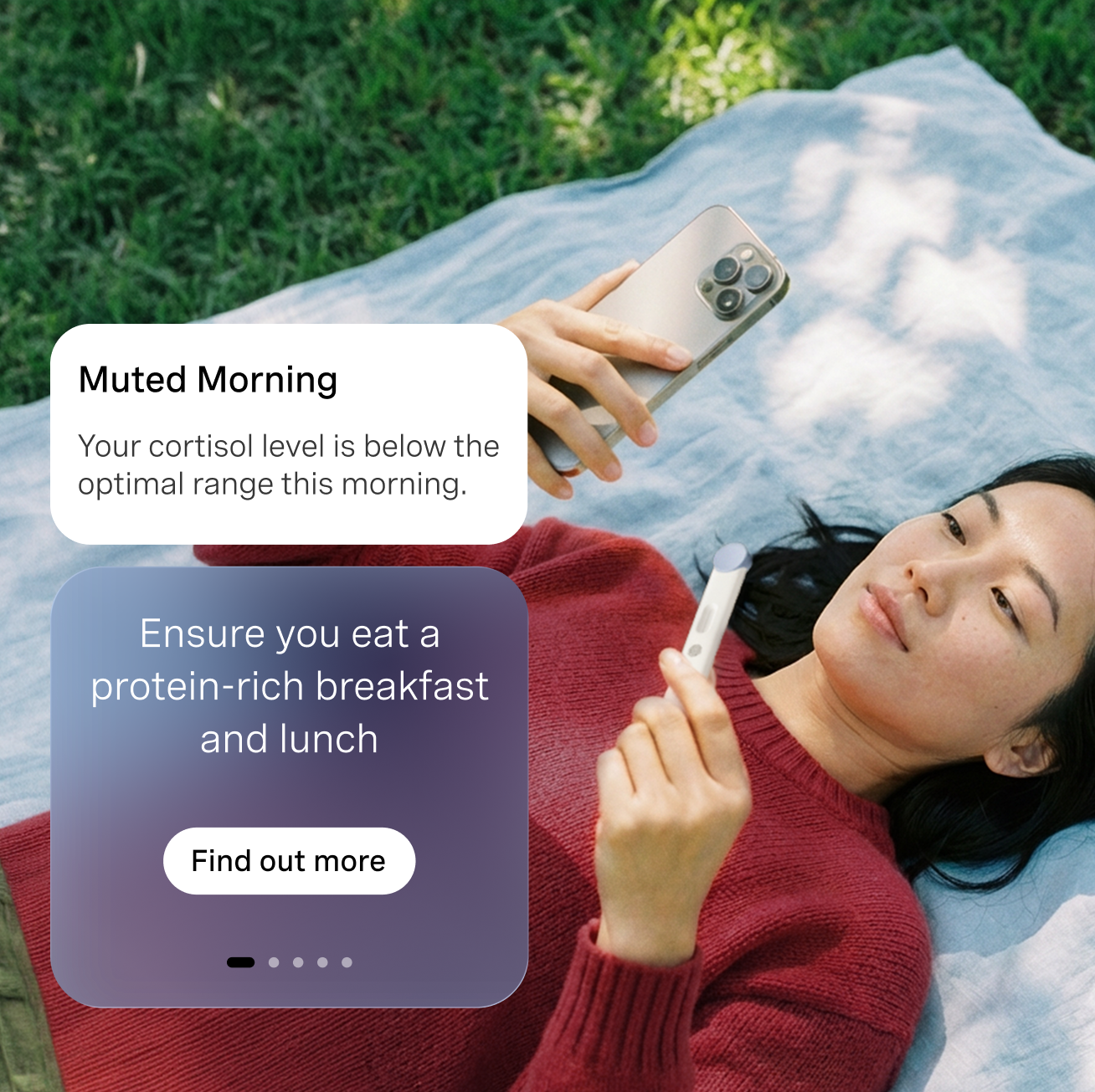
Tuesday morning, before training, Meaghan woke around 5 AM and tested immediately. Her cortisol awakening response was blunted. The CAR, the rise in cortisol that occurs in the first 30 to 45 minutes after waking, is one of the more sensitive indicators of cumulative stress load in athletes. A suppressed CAR after a day that did not involve hard training points to incomplete recovery from the stress that came before it.
Tuesday evening, post tempo bike and strength. Cortisol was elevated after this session, but this was an expected result. Tempo plus lactate shuttling plus strength is exactly the kind of multi-system stimulus that drives a cortisol response. The important signal here is the one that did not appear: her levels came back down to normal before bed. Recovery was able to begin normally.
Wednesday, all readings in range. A Z2 run on hilly terrain, no cortisol response, no residual elevation. By mid-week, Meaghan's pattern had stabilized.

3 things her cortisol revealed, backed by research
01. Underfueling amplifies the cortisol response. Meaghan's 540% spike was not just about the intensity of her session. The depleted state she described—shaky, brain fog, no real fuel going in—likely compounded the hormonal output. Cortisol is part of the body's glucose-mobilization response. When energy is scarce, the signal gets louder.
02. The spike is not the story, but what follows it is. Elevated cortisol after a hard workout is normal physiology. Elevated cortisol after a recovery ride is not. A blunted morning rise on a rest day also suggests the body hasn't caught up. These are the readings that show whether an athlete is absorbing training stress or accumulating it.
03. Evening cortisol may be a more sensitive training marker than morning cortisol. Meaghan's morning readings were largely within range throughout the week. Her out-of-range values showed up in the afternoon and evening, on the days when her system was still carrying load from prior sessions. For endurance athletes tracking recovery, the post-workout and evening windows appear to carry more signal than the awakening read alone.
What this means for athletes
Cortisol testing doesn't tell you how hard to train—but it can tell you whether your body has processed the strain it was under during training.
The most useful application of Meaghan's data is not the Sunday spike. It's the Monday and Tuesday readings that follow it, taken after sessions that should have produced no stress response at all. That gap between what the workout demanded and what the data shows is where real recovery information lives.
One reading is a number. A week of readings is a pattern. The pattern is what tells you whether you are building fitness or accumulating fatigue.
Meaghan Praznik tracked her cortisol diurnal curve with Eli Health across one training week. Data shared with her consent. Individual results vary, observational study.