At-Home Cortisol Testing: What It Is, How It Works & What to Expect
Cortisol is your body's primary stress hormone, but its influence reaches far beyond stress. It shapes energy, sleep quality, athletic recovery, and metabolic regulation. When cortisol shifts out of its typical daily pattern, the downstream effects are wide-ranging and often go unnoticed.
At-home cortisol testing lets you check your cortisol levels at home, on your own schedule, in the conditions of your real daily life.
This guide covers what cortisol tests measure, how different at-home methods compare, how to collect a sample correctly, and how to make sense of your results.
Ready to track your cortisol at home?
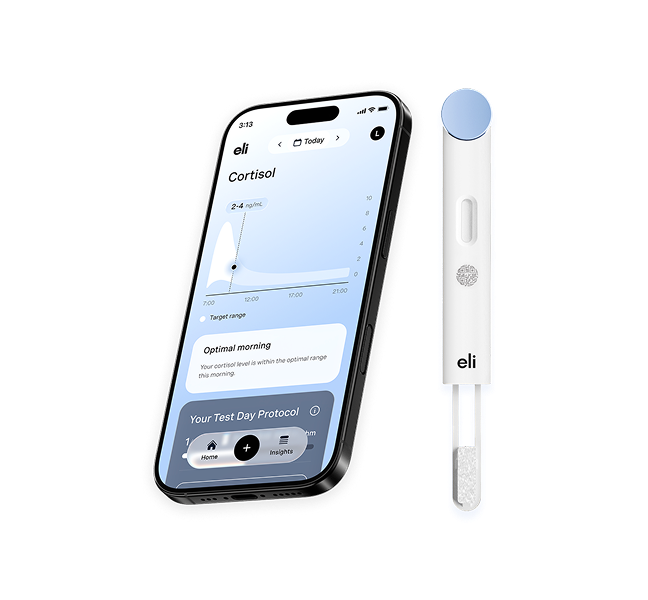
Hormometer™ delivers cortisol insights in about 20 minutes, at home.
What Is Cortisol and Why Does It Matter?
Cortisol is a glucocorticoid hormone produced by the adrenal glands. It is released in response to signals from the hypothalamic-pituitary-adrenal (HPA) axis, a feedback loop connecting the brain to the endocrine system.
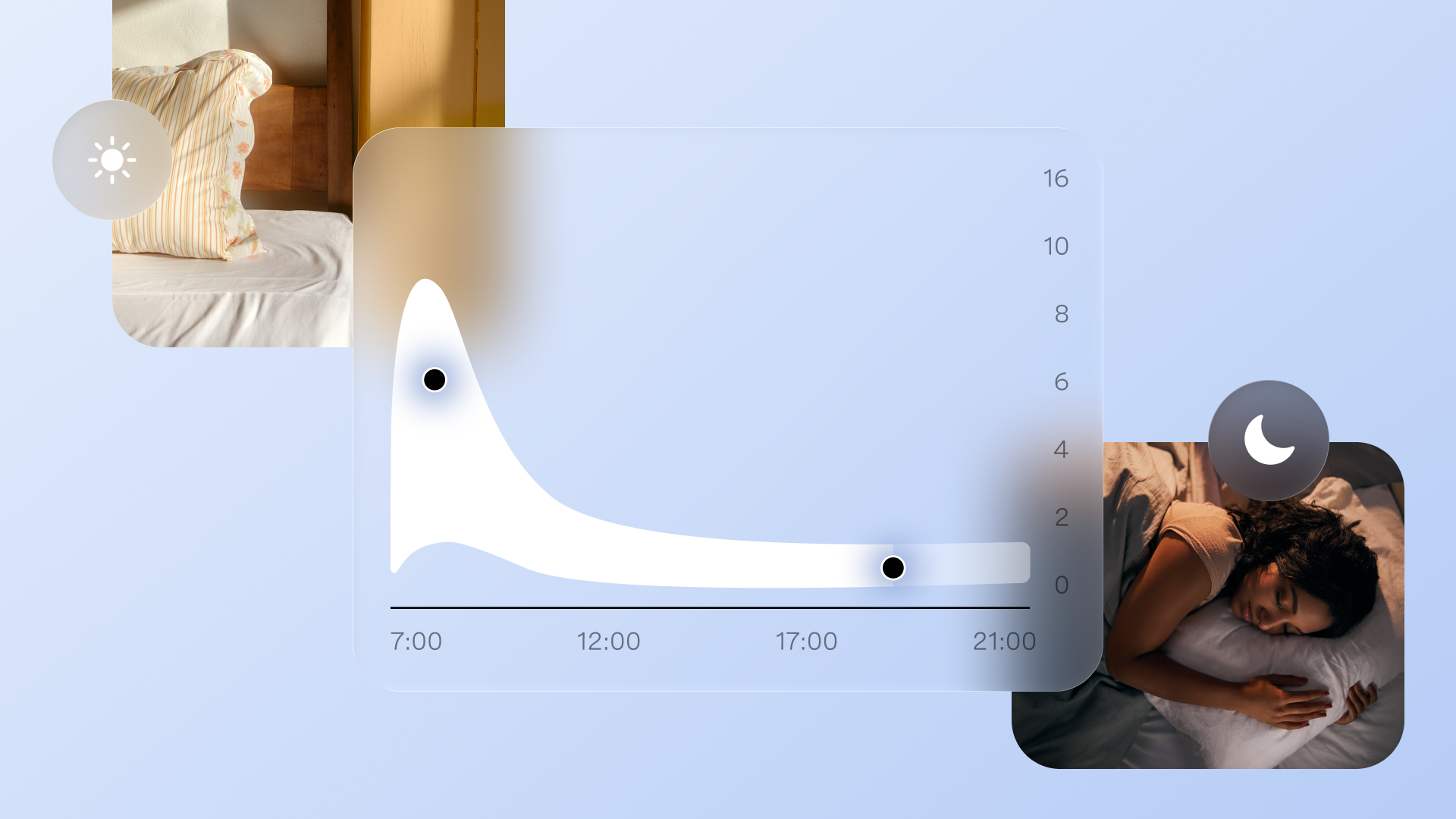
In healthy adults, cortisol typically follows a consistent daily rhythm, rising sharply in the first 30 to 45 minutes after waking, peaking in the early morning, then gradually declining through the afternoon and evening. This pattern, known as the diurnal cortisol curve, reflects how the body regulates its stress response across the day.
Pruessner JC, Wolf OT, Hellhammer DH, et al. (1997). "Free cortisol levels after awakening: a reliable biological marker for the assessment of adrenocortical activity." Life Sciences. 61(26):2539–2549.
https://pubmed.ncbi.nlm.nih.gov/9416776/
Adam EK, Quinn ME, Tavernier R, et al. (2017). "Diurnal cortisol slopes and mental and physical health outcomes: a systematic review and meta-analysis." Psychoneuroendocrinology. 83:25–41.
https://pmc.ncbi.nlm.nih.gov/articles/PMC5568897/
Free cortisol vs. total cortisol: why the distinction matters
Most cortisol in the bloodstream is bound to proteins, primarily cortisol-binding globulin (CBG). This bound cortisol is biologically inactive. Free cortisol is the small fraction that is not protein-bound and is therefore available to act on cells and tissues throughout the body.
Blood tests measure total cortisol, including both bound and free fractions. Salivary tests measure free cortisol, the biologically active portion. Decades of research have established that free cortisol in saliva closely reflects the physiologically active fraction, making salivary testing a well-validated approach for tracking the body's active cortisol response in everyday conditions.
Kirschbaum C, Hellhammer DH (1994). "Salivary cortisol in psychoneuroendocrine research: recent developments and applications." Psychoneuroendocrinology. 19(4):313–333.
https://pubmed.ncbi.nlm.nih.gov/8047637/
Hellhammer DH, Wüst S, Kudielka BM (2009). "Salivary cortisol as a biomarker in stress research." Psychoneuroendocrinology. 34(2):163–171.
https://pubmed.ncbi.nlm.nih.gov/19095358/
What cortisol regulates
- Blood glucose: triggers glucose release from the liver to provide fast energy
- Immune response: suppresses inflammation (useful short-term; sustained elevation affects immune function)
- Sleep-wake cycles: cortisol and melatonin operate in opposition; disrupted cortisol patterns can affect the sleep-wake signal
- Metabolism: influences how the body manages energy and stores fat, particularly under chronic stress
- Athletic performance and recovery: cortisol rises during training; recovery depends on it returning toward baseline between sessions
- Mood and cognition: cortisol levels are associated with changes in energy, focus, and emotional resilience
What happens when cortisol patterns shift?
Cortisol pattern shifts exist on a spectrum. They can show up as sustained elevation (the stress response staying active longer than needed), a blunted morning response (the natural waking surge not occurring as expected), or an inverted pattern (lower in the morning, elevated in the evening).
All three have distinct effects on energy, sleep, and recovery. All three are trackable with at-home salivary testing. None of them show up in a single reading; they become visible only across repeated tests over time.
Cortisol patterns are measurable, not just a feeling.
Hormometer™ gives you an on-demand view of your cortisol curve: morning, evening, and whenever you want one.
Who Can Benefit from Tracking Their Cortisol?
Cortisol tracking is relevant for anyone whose energy, sleep, performance, or wellness goals may be connected to how their body manages stress. These groups tend to find at-home cortisol tracking most useful:
Cortisol Testing for Chronic Stress
When the stress response stays active beyond what the situation requires, cortisol can remain elevated for sustained periods, which is associated with effects on immune function, sleep quality, fat storage, and cognitive performance. Tracking cortisol gives you a measurable view of what your body is doing under stress, rather than relying only on how stressed you feel.
Cortisol Testing for Poor Sleep and Low Energy
Cortisol and sleep are bidirectionally linked. Elevated evening cortisol can delay sleep onset and reduce sleep quality. A weak or absent morning response (when the natural wake-up surge does not occur as expected) can leave you feeling unrefreshed even after a full night's sleep. Tracking both morning and evening cortisol reveals which pattern may be contributing to sleep and energy challenges.
Cortisol Testing for Burnout
Burnout is associated with a distinct cortisol pattern: a blunted morning response, a flattened daily curve, and in some cases elevated evening levels. These patterns reflect a stress system that has shifted from overactivation toward depletion, where the morning surge that normally drives energy and motivation is no longer occurring as expected.
Mommersteeg PMC, Keijsers GPJ, Heijnen CJ, et al. (2015). "Burnout and cortisol: evidence for a lower cortisol awakening response in both clinical and non-clinical burnout." Journal of Psychosomatic Research. 78(5):445–451.
https://pubmed.ncbi.nlm.nih.gov/25433974/
Chida Y, Steptoe A (2009). "Cortisol awakening response and psychosocial factors: a systematic review and meta-analysis." Biological Psychology. 80(3):265–278.
https://pubmed.ncbi.nlm.nih.gov/19022335/
Cortisol Testing for Athletes and Performance Recovery
Cortisol rises during training as part of the normal stress-adaptation process. Recovery depends on cortisol returning toward baseline between sessions. When training load outpaces recovery, cortisol can stay elevated, which may affect muscle repair, energy, and performance adaptation over time. Tracking the morning and evening curve gives athletes a data point on recovery status alongside subjective wellness scores.
Cortisol Testing for Metabolism and Weight Management
Cortisol influences metabolic function, including how the body manages blood glucose and tends to store fat under chronic stress. People focused on weight management or body composition, particularly those noticing changes in energy or fat distribution, may find cortisol tracking a useful complement to their existing health practices.
Your wellness data, in 20 minutes.
Hormometer™ maps your cortisol patterns and connects them to your sleep, activity, and stress context.
Why Track Cortisol at Home?
Collecting a sample in your everyday environment captures cortisol under natural, real-life conditions. Because the anticipation of an appointment can itself raise cortisol, at-home collection can give a more representative picture of your typical daily pattern.
A single measurement, taken once at one time point, captures a snapshot of the diurnal curve. Depending on the question you are trying to answer, that snapshot can be exactly what you need, or only part of the picture. This is why the number of time points, and when they are taken, changes what a cortisol test can tell you.
What a single cortisol reading misses
Everyday pattern shifts (the kind associated with fatigue, poor recovery, and sustained stress) often appear as a blunted morning response, a flattened afternoon decline, or an elevated evening reading. None of these are visible from a single time point. A systematic review and meta-analysis of 80 studies found a significant relationship between a flatter diurnal cortisol slope and poorer outcomes across physical and mental health domains.
Adam EK et al. (2017). "Diurnal cortisol slopes and mental and physical health outcomes: a systematic review and meta-analysis." Psychoneuroendocrinology. 83:25–41.
https://pmc.ncbi.nlm.nih.gov/articles/PMC5568897/
Nater UM et al. (2016). "Use of salivary diurnal cortisol as an outcome measure in randomised controlled trials: a systematic review." Psychoneuroendocrinology.
https://pmc.ncbi.nlm.nih.gov/articles/PMC4823366/
One reading is not enough to understand your cortisol pattern.
Hormometer™ lets you test anytime: morning, evening, after a workout, after a stressful meeting.
Types of Cortisol Tests: How They Differ
Cortisol can be measured in different ways, and each method is built for a different question. Blood tests measure total cortisol and are the tool clinicians use when cortisol needs to be assessed in a medical setting. Salivary tests measure free cortisol, the biologically active fraction, and are the method validated in research for tracking your daily cortisol pattern. Among salivary tests, some are mailed to a lab for processing and some deliver results at home. These methods answer different questions and are best understood as complementary.
If your goal is to track your own cortisol pattern day to day, at-home salivary testing is the relevant category. Here is how the two at-home saliva options compare:
| Saliva test, mail-in | nstant saliva test (Hormometer™) | |
|---|---|---|
| What it measures | Free (bioavailable) cortisol | Free (bioavailable) cortisol |
| Where it's processed | Mailed to a lab | At home, in the Eli app |
| Sampling | Multiple samples, self-collected | Multiple samples, self-collected |
| Timing precision | Self-reported by user | Automatic timestamp at scan |
| Time to results | 3 to 7 business days | About 20 minutes |
| Best for | Daily pattern tracking | Daily pattern tracking |
DISCLAIMER: The Hormometer™ is a general wellness tracking tool, not a medical device. It is not intended to diagnose, screen for, or monitor any medical condition. The table above is provided for informational context only.
Among at-home salivary options, instant devices like the Hormometer™ add the timing precision and same-day results that mail-in kits cannot offer.
What Is an Instant At-Home Cortisol Test?
An instant at-home cortisol test delivers results within minutes, with no appointment and no mailing samples away. With the eli.health Hormometer™, you collect a saliva sample, scan the test strip with your smartphone camera through the Eli app, and receive your cortisol levels and wellness score in about 20 minutes. Most other at-home cortisol options mail your sample to a lab and take 3 to 7 business days to return results. Instant testing is what lets you check your cortisol today: after a workout, a stressful event, or first thing in the morning.
Kudielka BM, Wüst S (2010). "Human models in acute and chronic stress: assessing determinants of individual HPA axis activity and reactivity." Stress. 13(1):1–14.
https://pubmed.ncbi.nlm.nih.gov/20085486/
Aardal E, Holm AC (1995). "Cortisol in saliva: reference ranges and relation to cortisol in serum." European Journal of Clinical Chemistry and Clinical Biochemistry. 33(12):927–932.
https://pubmed.ncbi.nlm.nih.gov/8620119/
Hormometer™ uses instant salivary testing: results in about 20 minutes, no appointment required.
Test anytime. Build your cortisol pattern. Understand what drives your stress and recovery.
How to Take an At-Home Instant Cortisol Test: Step-by-Step
You'll need: a Hormometer™ cortisol test and your iPhone. The Eli app guides you through every step with built-in timers, so no external instructions are needed once you're set up.
Before you test
Do not eat, drink (except plain water), brush teeth, or smoke for at least 30 minutes before testing. Skip biotin supplements for 24 hours before testing, as biotin can interfere with the test chemistry. Have the Eli app open and ready before you begin.


Step 01
Saturate the sponge with saliva
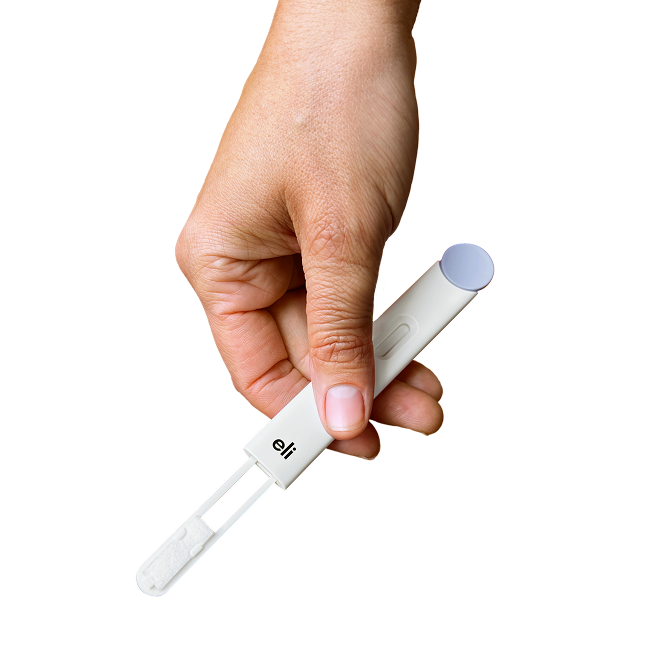
Following the in-app instructions, place the sponge end of the Hormometer™ test strip in your mouth. The app runs a 1-minute timer for saliva sampling. The sponge must be fully saturated; light contact with the tongue is not sufficient and is the most common cause of failed tests.
Step 02
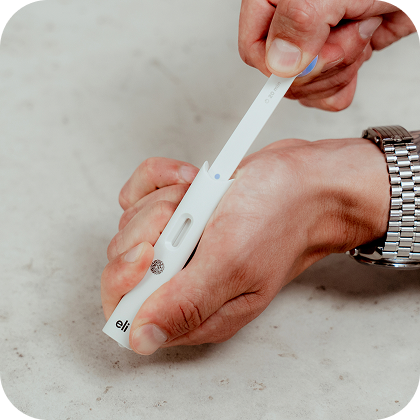
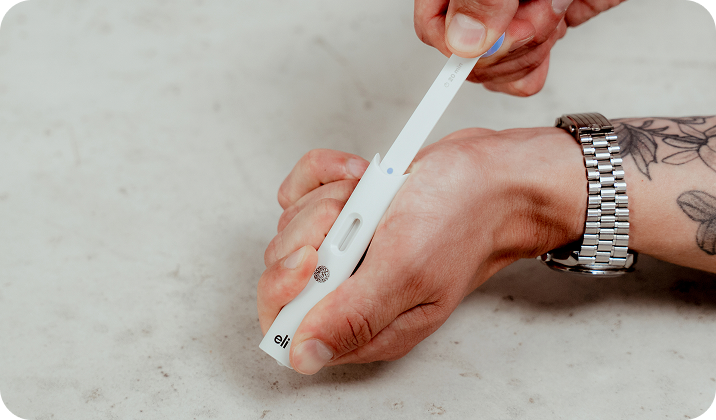
Pull the tab and wait 20 minutes
Pull the test tab firmly and completely until the entire blue dot is revealed. Place the strip on a flat, well-lit surface. The app runs a 20-minute development timer; do not scan before it completes.
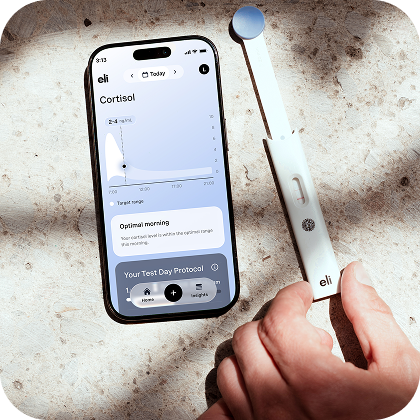
Step 03
Scan and get your results
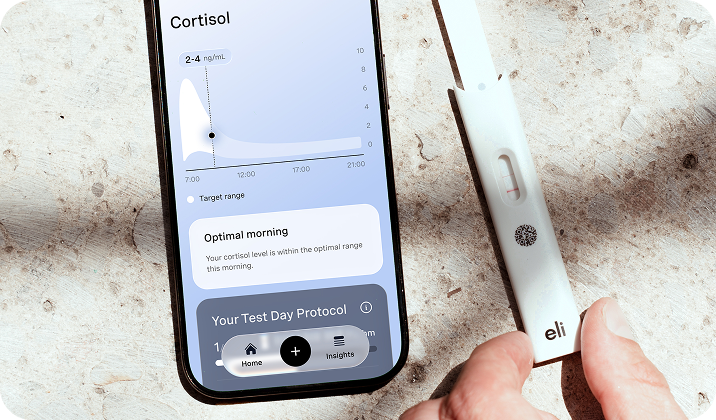
When the timer completes, the app prompts you to scan the test strip using your iPhone camera through the Eli app. Results appear immediately: your cortisol level and where it sits within the healthy population range for that time of day.
You can then log a lifestyle event (exercise, sleep, stress, medications, or anything else relevant) to give your result context. Over time, these logs connect your cortisol patterns to the specific factors driving them.
After 8 tests (4 diurnal curves), the app generates your Stress Status: a personalized summary of your cortisol rhythm to guide your next steps.
Recommended testing cadence
Morning test: within 30 to 45 minutes of waking. Captures the cortisol awakening response (CAR), the natural morning surge. Expert consensus guidelines specify that the first sample should be collected immediately upon waking, with a second sample at precisely 30 minutes post-waking. The Hormometer™ automatically timestamps each scan, capturing the interval accurately without relying on self-reported timing.
Stalder T, Kirschbaum C, Kudielka BM, et al. (2015). "Assessment of the cortisol awakening response: expert consensus guidelines." Psychoneuroendocrinology. 63:414–432.
https://pubmed.ncbi.nlm.nih.gov/25617346/
Clow A, Thorn L, Evans P, Hucklebridge F (2012). "Delays of 5–15 min between awakening and the start of saliva sampling matter in assessment of the cortisol awakening response." Psychoneuroendocrinology. 38(6):1001–1007.
https://pubmed.ncbi.nlm.nih.gov/23107441/
Evening test: between 5:00 and 10:00 PM. Captures the low point of the daily rhythm. Reveals whether cortisol is winding down appropriately or remaining elevated into the evening, which can affect sleep onset and quality.
Spot testing: anytime. Test after workouts, stressful events, travel, relaxation practices, or any moment you want to understand. The Hormometer™ is built for on-demand cortisol data.
Your kit. Your schedule. Your results in 20 minutes.
Collect saliva. Scan with your phone. See your cortisol levels.
When to Test: Timing and Cortisol Accuracy
Cortisol follows a dynamic daily rhythm and responds to training load, sleep quality, and life stress. Testing consistently, at the same time of day and under comparable conditions, gives you the most useful pattern data.
Why timing precision matters for the CAR
The cortisol awakening response is one of the most informative windows in the daily curve, but it requires precise timing to measure accurately. Research shows that a delay of as little as 5 to 15 minutes between waking and the first sample can meaningfully affect CAR calculations.
This is one reason self-reported timing can introduce variability. The Hormometer™ addresses it directly: each scan is automatically timestamped at the moment of collection, removing the reliance on self-reported timing.
Stalder T, Kirschbaum C, Kudielka BM, et al. (2015). "Assessment of the cortisol awakening response: expert consensus guidelines." Psychoneuroendocrinology. 63:414–432.
https://pubmed.ncbi.nlm.nih.gov/25617346/
Clow A, Thorn L, Evans P, Hucklebridge F (2012). "Delays of 5–15 min between awakening and the start of saliva sampling matter in assessment of the cortisol awakening response." Psychoneuroendocrinology. 38(6):1001–1007.
https://pubmed.ncbi.nlm.nih.gov/23107441/
Choose representative conditions
- For baseline mapping: test on a typical day, not during an unusual period of stress, illness, or travel
- For athletes: morning tests on rest or easy days provide the clearest recovery baseline
- For sleep insights: pair a morning and evening test on the same day to see your full daily arc
- For stress triggers: spot test right after a stressful event to observe your cortisol response
Cycle timing (for people with a menstrual cycle)
Cortisol levels vary across the menstrual cycle. Research shows circulating cortisol tends to be higher in the follicular phase than in the luteal phase, useful context when comparing results across different cycle phases.
Hamidovic A, Karapetyan K, Serdarevic F, et al. (2020). "Higher circulating cortisol in the follicular vs. luteal phase of the menstrual cycle: a meta-analysis." Frontiers in Endocrinology. 11:311.
https://pmc.ncbi.nlm.nih.gov/articles/PMC7280552/
Kereliuk SM, et al. (2023). "The cortisol levels in the follicular and luteal phases of the healthy menstruating women: a meta-analysis."
European Review for Medical and Pharmacological Sciences. PMID: 37750645. https://pubmed.ncbi.nlm.nih.gov/37750645/
A note on hormonal life stages
Cortisol interacts with other hormones, and its daily pattern can shift during periods of hormonal change. General research describes the HPA axis becoming more reactive as reproductive hormones fluctuate, with the morning peak sometimes less pronounced and the diurnal curve flatter. Many everyday experiences during these periods, such as disrupted sleep, fatigue, mood changes, and shifts in energy, overlap with cortisol pattern changes, which is part of why they can be hard to tell apart.
Hantsoo L, Payne JL (2023). "The role of the hypothalamic-pituitary-adrenal axis in depression across the female reproductive lifecycle." Frontiers in Endocrinology. 14:1295261. https://pmc.ncbi.nlm.nih.gov/articles/PMC10750128/
Kuebler U, et al. (2022). "Steroid hormone secretion over the course of the perimenopause: findings from the Swiss Perimenopause Study."Frontiers in Global Women's Health. 2:774308. PMID: 34970652. https://pubmed.ncbi.nlm.nih.gov/34970652/
Test in the morning.
Test in the evening.
Test after a workout.
The Hormometer™ is built for real life and continuous cortisol tracking, anywhere, anytime.
How to Read Your Cortisol Test Results
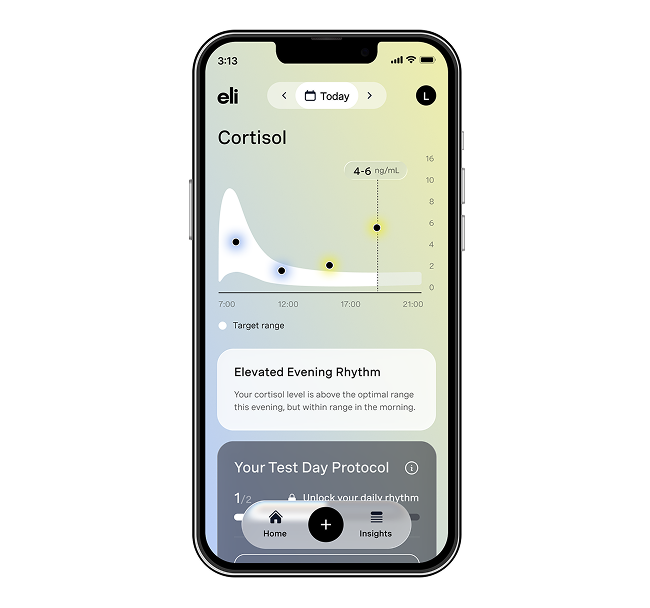
After scanning your test, the Eli app displays where your cortisol level sits within the healthy population range for that time of day. Results are best interpreted as patterns over time, not as individual readings. A single test tells you where you are right now. A series of tests across days and weeks reveals what is actually driving your stress, energy, and recovery cycle.
After 8 tests across 4 diurnal curves, the app generates your Stress Status, a personalized summary of your cortisol pattern across five states: Balanced, Strained, Depleted, Activated, or Overextended. This is where individual data points become actionable: your Stress Status tells you whether your rhythm is regulated or disrupted, and guides your next steps.
What your morning reading tells you
Your morning cortisol, taken within 30 to 45 minutes of waking, captures the cortisol awakening response. A consistent morning response is associated with healthy energy mobilization and stress resilience across the day. Many people experiencing sustained burnout or fatigue notice a weak or absent morning response when they start tracking regularly.
Pruessner JC, Wolf OT, Hellhammer DH, et al. (1997). "Free cortisol levels after awakening: a reliable biological marker for the assessment of adrenocortical activity." Life Sciences. 61(26):2539–2549.
https://pubmed.ncbi.nlm.nih.gov/9416776/
Stalder T, Kirschbaum C, Kudielka BM, et al. (2015). "Assessment of the cortisol awakening response: expert consensus guidelines." Psychoneuroendocrinology. 63:414–432.
https://pubmed.ncbi.nlm.nih.gov/25617346/
What your evening reading tells you
Your evening cortisol, taken between 5:00 and 10:00 PM, captures how well your stress system is winding down. Cortisol should be low at this point. When evening readings are consistently elevated, many people report difficulty falling asleep or feeling mentally active when they want to rest.
What your trend over time tells you
The real value of continuous tracking is what emerges across repeated tests. Comparing morning and evening cortisol across days and weeks reveals how your body responds to different types of training, which types of stress produce the highest cortisol spikes, whether lifestyle changes are having a measurable effect, and how long your stress response takes to recover after a demanding period.
- High and slow to decline: the stress response staying active longer than expected, commonly associated with chronic stress and difficulty winding down
- Flat with a weak morning peak: associated with burnout, sustained fatigue, and depleted stress resilience
- Elevated in the evening: often connected to disrupted sleep, racing thoughts at bedtime, and stimulant or screen exposure late in the day
- Inverted (low in the morning, higher at night): a pattern associated with disrupted circadian rhythm, shift work, or significant lifestyle stress
Adam EK, Quinn ME, Tavernier R, et al. (2017). "Diurnal cortisol slopes and mental and physical health outcomes: a systematic review and meta-analysis." Psychoneuroendocrinology. 83:25–41.
https://pmc.ncbi.nlm.nih.gov/articles/PMC5568897/
Kudielka BM, Gierens A, Hellhammer DH, Wüst S, Schlotz W (2012). "Salivary cortisol in ambulatory assessment." Psychosomatic Medicine. 74(4):418–431. https://pubmed.ncbi.nlm.nih.gov/22582339/
When to speak with a healthcare professional
If your readings are consistently outside the typical wellness range, the Eli app will let you know. This is not a clinical finding; it is a signal worth discussing with a healthcare professional who can provide the medical context a wellness tracking tool is not designed to offer. If you have health concerns related to your cortisol levels, consult your healthcare provider.
Wellness disclaimer: The Eli instant cortisol test is a general wellness tracking tool. It is not intended to diagnose, treat, manage, prevent, or cure any disease or medical condition, including adrenal disorders. Results provide lifestyle and wellness insights only. Always consult a licensed healthcare professional for medical concerns or before making changes to medications or treatment plans.
Your cortisol pattern, explained in plain language.
The Eli app turns your readings into personalized wellness insights.
FAQ
Explore the Hormone Lab for in-depth coverage of specific cortisol topics.
CORTISOL
Best Time of Day to Test Cortisol
The right timing unlocks insight, as testing strategically is essential to understanding what shapes your personal cortisol pattern.
CORTISOL
How to Read Your Cortisol Results
Rhythm Review shows you common trends in your cortisol rhythm across mornings, evenings, and full days so you can see how your body manages stress across each day.

CORTISOL
Saliva vs. Blood Cortisol Tests
Blood and saliva cortisol tests both measure cortisol — but they don't measure the same thing. Learn how each method works, what each one is designed to tell you, and how to choose the right test for your goals.
CORTISOL
Signs Your Cortisol Patterns May Be Off
Fatigue, mood shifts, disrupted sleep — these signs can point to cortisol running too high or too low. Here's how to tell the difference, and what to do next.

CORTISOL
Cortisol and Stress: The Connection
Cortisol isn't the enemy. It's your body's first responder. Here's how the stress response actually works, and how to recognize when it stops switching off.
Scientific References
Pruessner JC, Wolf OT, Hellhammer DH, et al. (1997). "Free cortisol levels after awakening: a reliable biological marker for the assessment of adrenocortical activity *." Life Sciences. 61(26):2539-2549.
https://pubmed.ncbi.nlm.nih.gov/9416776/
Kirschbaum C, Hellhammer DH (1994). "Salivary cortisol in psychoneuroendocrine research: recent developments and applications *." Psychoneuroendocrinology. 19(4):313–333.
https://pubmed.ncbi.nlm.nih.gov/8047637/
Hellhammer DH, Wüst S, Kudielka BM (2009). "Salivary cortisol as a biomarker in stress research *." Psychoneuroendocrinology. 34(2):163-171.
https://pubmed.ncbi.nlm.nih.gov/19095358/
Kudielka BM, Wüst S (2010). "Human models in acute and chronic stress: assessing determinants of individual HPA axis activity and reactivity *." Stress. 13(1):1-14.
https://pubmed.ncbi.nlm.nih.gov/20085486/
Kudielka BM, Gierens A, Hellhammer DH, Wüst S, Schlotz W (2012). "Salivary cortisol in ambulatory assessment: some dos, some don'ts, and some open questions *." Psychosomatic Medicine. 74(4):418-431.
https://pubmed.ncbi.nlm.nih.gov/22582339/
Stalder T, Kirschbaum C, Kudielka BM, et al. (2015). "Assessment of the cortisol awakening response: expert consensus guidelines *." Psychoneuroendocrinology. 63:414-432.
https://pubmed.ncbi.nlm.nih.gov/25617346/
Clow A, Thorn L, Evans P, Hucklebridge F (2012). "Delays of 5-15 min between awakening and start of saliva sampling matter in CAR assessment *." Psychoneuroendocrinology. 38(6):1001-1007.
https://pubmed.ncbi.nlm.nih.gov/23107441/
Aardal E, Holm AC (1995). "Cortisol in saliva: reference ranges and relation to cortisol in serum *." European Journal of Clinical Chemistry and Clinical Biochemistry. 33(12):927-932.
https://pubmed.ncbi.nlm.nih.gov/8620119/
Adam EK, Quinn ME, Tavernier R, et al. (2017). "Diurnal cortisol slopes and mental and physical health outcomes: a systematic review and meta-analysis." Psychoneuroendocrinology. 83:25-41.
https://pmc.ncbi.nlm.nih.gov/articles/PMC5568897/
Nater UM et al. (2016). "Use of salivary diurnal cortisol as an outcome measure in randomised controlled trials: a systematic review." Psychoneuroendocrinology.
https://pmc.ncbi.nlm.nih.gov/articles/PMC4823366/
Hamidovic A, Karapetyan K, Serdarevic F, et al. (2020). "Higher circulating cortisol in the follicular vs. luteal phase of the menstrual cycle: a meta-analysis." Frontiers in Endocrinology. 11:311.
https://pmc.ncbi.nlm.nih.gov/articles/PMC7280552/
Mommersteeg PMC, Keijsers GPJ, Heijnen CJ, et al. (2015). "Burnout and cortisol: evidence for a lower cortisol awakening response." Journal of Psychosomatic Research. 78(5):445-451.
https://pubmed.ncbi.nlm.nih.gov/25433974/
Chida Y, Steptoe A (2009). "Cortisol awakening response and psychosocial factors: systematic review and meta-analysis." Biological Psychology. 80(3):265-278.
https://pubmed.ncbi.nlm.nih.gov/19022335/
Kudielka BM, Hellhammer DH, Wüst S (2009). "Why do we respond so differently? Reviewing determinants of salivary cortisol responses to challenge." Psychoneuroendocrinology. 34(1):2-18.
https://pubmed.ncbi.nlm.nih.gov/18986772/
Segerstrom SC et al. (2023). "Reliability of diurnal salivary cortisol metrics: meta-analysis." Psychoneuroendocrinology.
https://pubmed.ncbi.nlm.nih.gov/37635863/